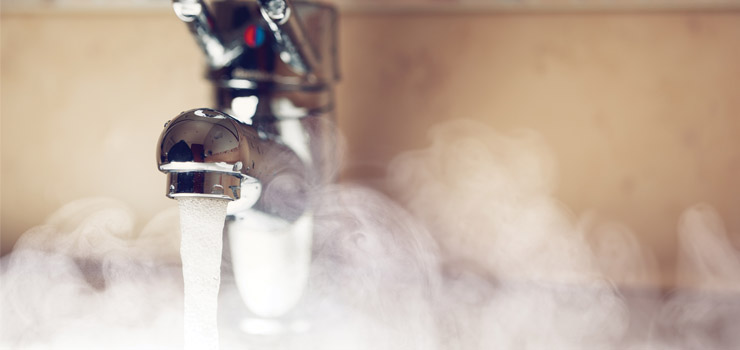
A fundamental rule of household safety in older buildings is often overlooked: never use hot tap water for cooking, drinking, or preparing baby formula. The reason is rooted in basic chemistry: hot water leaches lead and other heavy metals from pipes and solder significantly more aggressively than cold water. In a historic Manhattan brownstone or a pre-1986 New Jersey row house, your hot water system is essentially a “High-Heat Chemical Reactor” inside your walls. At Lead Free Homes, we focus on the thermal dynamics of lead leaching. Understanding the “Aggression of Heat” is the first step in engineering a safer daily routine.
The Kinetic Energy of Leaching
From a chemical engineering perspective, leaching is a process where metal ions move from the solid pipe into the liquid water. This reaction requires energy. Heat provides that energy in the form of “Kinetic Energy.” High-temperature water molecules move faster and collide with the lead surfaces inside your pipes more frequently and with more Force. This breaks the chemical bonds of the lead metal more easily, allowing it to enter the water stream at a much higher rate. Studies have shown that lead levels in hot water can be several times higher than in cold water from the same tap. This is a critical health advisory from the CDC that every parent should know.
This kinetic advantage is why we emphasize that baby formula should only be made with cold, filtered water that is then heated on the stove or in a kettle. By starting with cold water, you minimize the “Chemical Extraction” that happens inside your building’s plumbing. Your water heater is not just a heater; it is a catalyst for heavy metal contamination. Respecting the temperature of your tap is a requirement for safety.
The Water Heater as a “Sediment Trap”
Your water heater (or the hot water tank in your basement) is the “Primary Collection Point” for all the sediment that enters your building. Over years of operation, these tanks accumulate a layer of “Grit and Scales” at the bottom. In older buildings, this sediment often includes lead scale, iron oxide, and manganese. Because the water in the tank is constantly being heated to 120-140°F, it is in a perpetual state of “Aggressive Leaching.” The water sitting at the bottom of your heater is often the most contaminated water in the entire building. When you turn on the hot tap, you are pulling from this concentrated reservoir.
Regular maintenance, such as “Flushing the Water Heater” annually, can help reduce the sediment load, but it won’t eliminate the underlying leaching issue if your building has lead pipes or solder. We recommend that residents in old neighborhoods treat hot water as “Utility Only”—for bathing and laundry, not for ingestion. If you need hot water for tea or coffee, always start with the cold tap and a kettle. This simple engineering bypass protects your family from the “Basement Reservoir” of legacy metals.
Corrosion of Copper and Solder Joints
Hot water isn’t just aggressive toward lead; it also accelerates the corrosion of the copper pipes and the lead solder joints that hold them together. High temperatures can damage the protective “Mineral Scale” that normally lines the inside of your pipes. When this scale is compromised by heat, the underlying metal is exposed to the water, leading to a spike in leaching. This is particularly problematic in homes with “Instant Hot Water” recirculation loops, where hot water is constantly pumped through the house’s vertical risers. In these systems, every joint is under a constant state of thermal attack.
Furthermore, the “Expanding and Contracting” of pipes during heating and cooling cycles can cause micro-cracks in old lead solder. These cracks increase the surface area of the lead exposed to the water, making the leaching process even more efficient. If your home has a legacy of 50/50 lead-tin solder, the hot water lines are the most likely failure points for water quality. Identifying these “High-Thermal Zones” is a key part of our forensic plumbing audits. Data-driven maintenance requires understanding the impact of temperature on material integrity.
The “Hot-Water-Tap” Myth
Many homeowners believe that “Filtering” the hot water tap is the same as filtering the cold water. However, most point-of-use filters (like pitcher filters or faucet attachments) are not designed to handle hot water. In fact, running hot water through a charcoal filter can permanently damage the filter media or cause it to release the contaminants it has already trapped. This is a “Dangerous Myth” that Lead Free Homes works to dispel. We provide clear guidelines on filter temperature limits. For safety, the “Lead-Safe Tap” is always the cold one.
If you are concerned about your hot water quality, the only permanent solution is to replace the lead risers and the service main. Short of that, the “Daily Bypass” is your best defense. By educating your family to never drink from the “Red Side” of the faucet, you eliminate a major source of heavy metal exposure with zero capital cost. Scientific habits are the cheapest form of engineering. Stay informed, stay vigilant, and always Know Your Tap. Clarity is a result of cool, moving water.
Technical Forensics: The Molecular Stability of Lead Scales
Diving deeper into the chemistry of stagnation, we must look at the “Molecular Stability” of the protective scale. In a typical 100-year-old pipe, the scale consists of cerussite (lead carbonate) and hydrocerussite. When water chemistry fluctuates, these minerals can transform or dissolve, releasing a flood of lead ions. Forensic analysis shows that even a 0.5 unit shift in pH can destabilize decades of accumulated protection. This is why we emphasize constant monitoring during municipal treatment changes. Your water is only as stable as the minerals lining your lead pipes. Integrity is a matter of chemical equilibrium.
“Mechanical Resonancy” and Particle Release
Another overlooked factor is “Mechanical Resonancy.” Older plumbing systems have specific “Natural Frequencies.” When heavy trucks pass or subway trains rumble nearby, they can trigger vibrations that match the resonance of your home’s piping. This mechanical energy is enough to fracture brittle lead solder or detach flakes of iron oxide. This creates a “Particulate Wave” that moves toward your tap. By understanding the vibration profile of your neighborhood, you can better predict when to expect these particulate spikes. Data-driven protection is the hallmark of modern urban living.
Conclusion: The Architecture of the Heat
Hot water’s aggressive leaching of lead is a technical certainty that requires an engineering-minded solution. By recognizing the roles of kinetic energy, sediment accumulation in tanks, thermal joint fatigue, and filter limitations, you can ensure your family’s safety in a historic home. Your tap is a portal to the past—ensure you are accessing it through the “Coolest” path possible. At Lead Free Homes, we provide the technical data and forensic strategies needed to help you find clarity and health in an aging city. A lead-free future is built on data and daily habits. Safety is a matter of temperature and truth.