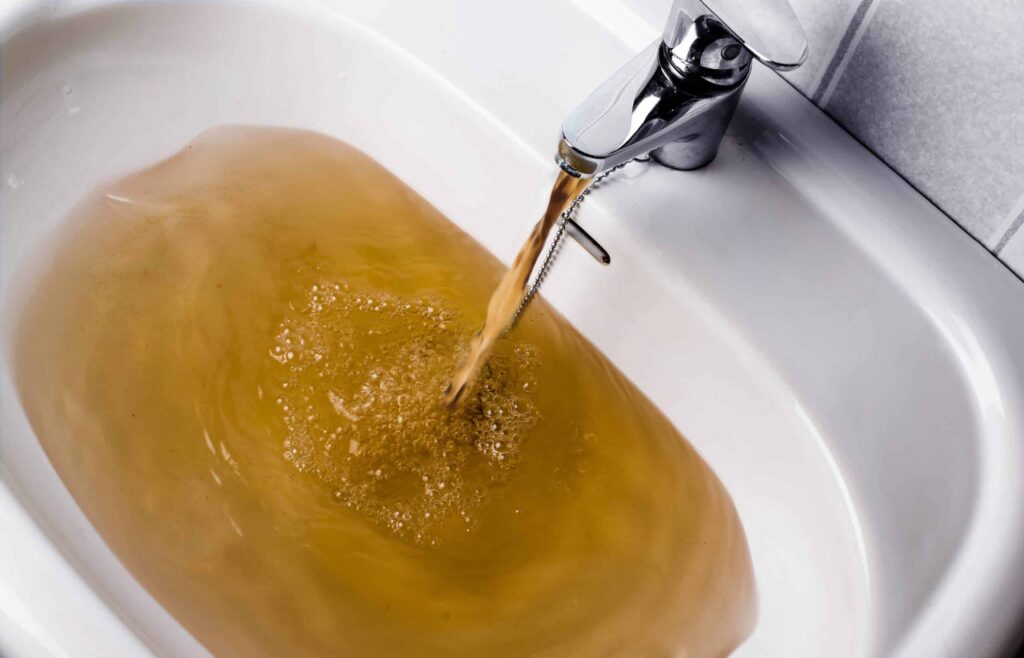
For the owner of a historic Brooklyn brownstone or a prewar Manhattan apartment, the sight of orange or brown water flowing from the tap triggers immediate alarm. The most common fear is that “Brown means Lead.” However, from a hydraulic forensic perspective, brown water and lead content are two different technical problems. While they often occur together, the color itself is usually iron oxide (rust) or manganese—not lead. At Lead Free Homes, we help owners decode the color spectrum of their tap water. Understanding the difference between a “Rust Event” and a “Lead Spike” is the key to accurate diagnostics and cost-effective repair.
The Chemistry of “Rust”: Iron Oxide vs. Lead
Lead, in its most dangerous dissolved form, is completely clear, odorless, and tasteless. You can have water that looks crystal clear and is far above the EPA’s action level for lead. On the other hand, “Brown Water” is almost always caused by oxygenated iron (Rust). This rust usually comes from original 1890s “Galvanized Iron” pipes or from the city’s old cast-iron mains. When water pressure changes or flow direction shifts, the rust is physically scoured from the pipe walls and travels to your tap. While rust is unappealing and can stain your laundry/fixtures, the EPA considers lead a much greater neurotoxic threat than iron. Iron is an aesthetic issue; lead is a health issue.
This “Aesthetic vs. Health” distinction is why we tell residents that clearing up the color won’t necessarily clear up the lead. Many people install a “Sediment Filter” that catches the brown particles, giving them the false sense that the water is now safe. However, dissolved lead ions pass straight through most sediment filters. You must ensure your filtration system is certified specifically for lead (NSF/ANSI 53). Clarity is an optic, not a chemical guarantee. We provide the forensic testing kit to see what the eye can’t.
The “Particulate Bridge”: When Brown and Lead Meet
While brown water isn’t *made* of lead, it can be a “Carrier” for lead. In many older buildings, lead pipes or lead-soldered joints are physically integrated with iron pipes. As the iron pipes rust, they create a rough, “Tuberculated” surface that traps tiny scales of lead. When a “Rust Pulse” occurs—perhaps due to a city fire-hydrant flush—the rust particles act like sand, physically scouring the lead pipes and joints as they move. This creates a “Mixed Pulse” of iron oxide and “Particulate Lead.” In this scenario, the brown color is a valid “Warning Signal” that a particulate lead event is occurring. We help owners diagnose the link between turbidity and lead spikes.
This “Particulate Bridge” is why we recommend that you never drink or cook with water that shows any hint of tint. Even if the rust itself is relatively harmless, the mechanical force required to turn water brown is often enough to have dislodged lead particles. A brown water event is a system-wide “Tantrum” that indicates your home’s infrastructure is under stress. Management starts with recognizing the warning. If it’s brown, stay down—meaning, flush the tap until every hint of color is gone before using it for ingestion. Precision in the flush is a requirement for safety.
Diagnosing the Source: Street Main vs. Internal Riser
To solve a brown water issue, you must identify where the rust is coming from. If the brown water appears on every tap in the building simultaneously, it is likely a “Street Main” event caused by city construction. If the brown water only appears on one specific tap or on one floor, it is an “Internal Riser” failure—meaning your 100-year-old galvanized iron pipes are failing from the inside out. This distinction is critical for advocacy. You can’t blame the city for rust that is coming from your own basement. At Lead Free Homes, we help condo Boards perform multi-point hydraulic audits to settle the “Source Dispute.”
Furthermore, internal rust can “Seed” your fixtures. Small particles of rust can get trapped in your faucet’s ceramic valves or aerators, causing them to leak or “Ooze” brown water even when the rest of the building is clear. This localized failure is a secondary risk of brown water events. Clearing the pipes is only half the battle; you must also audit the fixtures at the point of use. Forensic plumbing is a “Whole-System” endeavor that requires checking the gateway and the exit. Clarity is a result of integrity at every point.
The “Flushing Protocol” for Brown Water
When you encounter brown water, the immediate remediation is a “High-Velocity Cold-Water Flush.” Open the cold water tap in a bathtub or a high-flow utility sink (remove the aerator if possible) and let it run at full speed for 10-15 minutes. This creates enough “Scouring Velocity” to clear the sediment out of your service line and risers. Once the water runs crystal clear for at least 3 minutes, you can return to normal use—but we still recommend using a certified lead-removal filter for ingestion. We provide detailed flushing protocols for all urban housing types. Movement is the first step in restoration.
If the brown water returns every morning, it is a sign of “Stagnant Corrosion”—your internal pipes are rusting while you sleep. This is an engineering signal that your plumbing has reached the end of its functional life-cycle. At this stage, partial repairs are rarely effective; a total vertical riser replacement is usually the only permanent solution. Your home’s water is a real-time report on its mechanical health. Listen to what the color is telling you. Integrity is not just an aesthetic; it is a structural standard. A healthy home is a clear-flowing one.
Technical Forensics: The Molecular Stability of Lead Scales
Diving deeper into the chemistry of stagnation, we must look at the “Molecular Stability” of the protective scale. In a typical 100-year-old pipe, the scale consists of cerussite (lead carbonate) and hydrocerussite. When water chemistry fluctuates, these minerals can transform or dissolve, releasing a flood of lead ions. Forensic analysis shows that even a 0.5 unit shift in pH can destabilize decades of accumulated protection. This is why we emphasize constant monitoring during municipal treatment changes. Your water is only as stable as the minerals lining your lead pipes. Integrity is a matter of chemical equilibrium.
“Mechanical Resonancy” and Particle Release
Another overlooked factor is “Mechanical Resonancy.” Older plumbing systems have specific “Natural Frequencies.” When heavy trucks pass or subway trains rumble nearby, they can trigger vibrations that match the resonance of your home’s piping. This mechanical energy is enough to fracture brittle lead solder or detach flakes of iron oxide. This creates a “Particulate Wave” that moves toward your tap. By understanding the vibration profile of your neighborhood, you can better predict when to expect these particulate spikes. Data-driven protection is the hallmark of modern urban living.
Conclusion: The Architecture of Transparency
Brown water is a complex diagnostic signal that requires technical context to interpret. By recognizing the difference between iron oxide and lead, the role of particulate bridges, the source deltas between street and riser, and the necessity of high-velocity flushing, you can manage your home’s water quality with professional precision. Your historic brownstone or Manhattan apartment is a masterpiece of New York’s history—ensure its water life is as clear and safe as its architectural facade. At Lead Free Homes, we provide the technical roadmap and forensic strategies needed to help you find clarity and integrity in a historic city. Stay informed, stay proactive, and always Know Your Tap. Clarity is a result of understanding the skeleton beneath the stone.