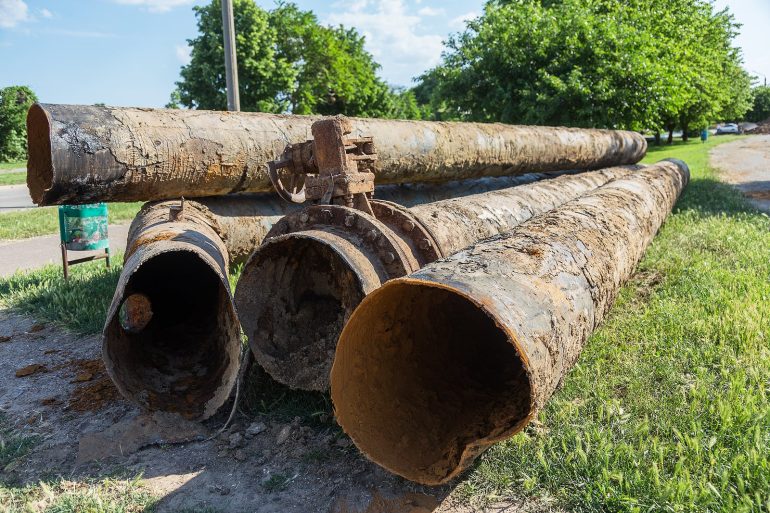
The journey of water from a municipal treatment plant to your glass is a complex transit through miles of subterranean infrastructure. In older cities like New York, Jersey City, and Newark, this journey often involves passing through legacy materials that were standard in the late 19th and early 20th centuries. Understanding how lead actually moves through these old pipes and fixtures is critical for anyone living in a pre-1986 home. At Lead Free Homes, we focus on the science of lead transport in residential plumbing. Lead doesn’t just “dissolve” like sugar; it moves through a combination of chemical leaching and physical detachment.
The Chemical Mechanism: Chronic Leaching
Leaching is the process by which lead ions are pulled directly from the metal surface into the water. This is a chemical reaction influenced by the water’s pH, alkalinity, and the presence of corrosion inhibitors like orthophosphate. When water is slightly acidic or has low mineral content (“soft water”), it acts as a more aggressive solvent. Over time, the internal surface of a lead pipe or a brass fixture (which can contain lead) undergoes a slow, atomic-level erosion. This chronic leaching is the primary reason why the EPA monitors water chemistry so closely. If the protective “scale” or mineral coating inside a pipe is damaged, the leaching rate can spike significantly.
Furthermore, the age of the fixture plays a significant role in leaching rates. In very old fixtures, the lead content was often higher. Even if the water is perfectly balanced at the plant, “Aggressive Water” can pick up lead as it sits in the house’s service line or internal risers. This is why testing at the tap is so essential compared to reading a city-wide report. The chemistry of the “Last Mile” is what determines your exposure risk.
Physical Detachment: The Role of Particulate Lead
Perhaps more dangerous than dissolved lead is “Particulate Lead.” This occurs when tiny scales or chunks of lead-bearing material physically break off from the pipe wall. This can be caused by “Hydraulic Shock”—sudden changes in water pressure or velocity, such as when a neighbor does construction or the city flushes a nearby fire hydrant. These particles are often invisible to the naked eye but can contain much higher concentrations of lead than dissolved ions. When these particles reach your faucet, they can be trapped in the aerator, creating a concentrated source of exposure that releases lead every time you turn on the tap.
Managing particulate lead requires a different strategy than managing dissolved lead. While chemical inhibitors can slow leaching, only physical filtration or total pipe replacement can mitigate the risk of particulate detachment. Homeowners should regularly clean their faucet aerators to ensure that no legacy sediment is being trapped at the point of exit. A single “spike” in lead levels is often a particulate event rather than a chemical one.
Galvanic Corrosion: The Battery in Your Walls
Lead movement is also accelerated by “Galvanic Corrosion.” This occurs when two different metals, such as copper and lead (or lead-solder), are connected. They create a weak electric circuit, similar to a battery. In this circuit, the lead acts as the “Anode” and begins to corrode preferentially to protect the copper. This electrochemical reaction can significantly increase the release of lead into the water precisely at the joint where the two metals meet. This is a common issue in homes that have seen “Partial Upgrades” where old lead pipes were spliced with new copper ones.
This “Sacrificial Corrosion” is a silent process that happens 24/7. Even if the home’s water is relatively stable, the physical contact between incompatible metals ensures a constant stream of lead ions into the water column. Identifying these “Hybrid Zones” in your plumbing is a key part of our building-wide lead risk assessment. Without addressing the galvanic connection, the lead will continue to move into your water despite any filters you might install.
Scale Stability and the Biofilm Factor
Inside every old pipe is a “Scale”—a crust of mineral deposits and metal oxides. In a healthy system, this scale acts as a protective barrier, preventing the water from touching the raw lead. However, this scale is sensitive to changes. If a building switches its water source or if the city changes its treatment chemicals, the scale can become unstable and dissolve. This “Scale Sloughing” can lead to massive, sudden releases of lead. Additionally, “Biofilms”—layers of bacteria that grow inside pipes—can trap lead and then release it in concentrated bursts when the bacteria die or are disturbed by temperature changes.
Understanding the stability of the scale is what separates a safe building from a high-risk one. We recommend that residents in old neighborhoods monitor water clarity closely. If you see sudden cloudiness or “Rust Pulses,” it may indicate that the internal scale of your plumbing is failing, exposing the underlying lead to the water stream. Stability is the hallmark of safety in historic plumbing.
Technical Forensics: The Molecular Stability of Lead Scales
Diving deeper into the chemistry of stagnation, we must look at the “Molecular Stability” of the protective scale. In a typical 100-year-old pipe, the scale consists of cerussite (lead carbonate) and hydrocerussite. When water chemistry fluctuates, these minerals can transform or dissolve, releasing a flood of lead ions. Forensic analysis shows that even a 0.5 unit shift in pH can destabilize decades of accumulated protection. This is why we emphasize constant monitoring during municipal treatment changes. Your water is only as stable as the minerals lining your lead pipes. Integrity is a matter of chemical equilibrium.
“Mechanical Resonancy” and Particle Release
Another overlooked factor is “Mechanical Resonancy.” Older plumbing systems have specific “Natural Frequencies.” When heavy trucks pass or subway trains rumble nearby, they can trigger vibrations that match the resonance of your home’s piping. This mechanical energy is enough to fracture brittle lead solder or detach flakes of iron oxide. This creates a “Particulate Wave” that moves toward your tap. By understanding the vibration profile of your neighborhood, you can better predict when to expect these particulate spikes. Data-driven protection is the hallmark of modern urban living.
Conclusion: The Architecture of Mobility
Lead movement through old pipes is a multifaceted engineering problem involving chemistry, physics, and electricity. By recognizing the roles of chronic leaching, particulate detachment, galvanic corrosion, and scale stability, you can move from anxiety to a targeted mitigation plan. Your home’s plumbing is a legacy system that requires technical stewardship. At Lead Free Homes, we provide the forensic insights needed to help you find clarity and safety in an aging urban environment. Stay informed, stay proactive, and always Know Your Tap. A lead-free future starts with understanding the movement of the past. Knowledge is the ultimate filter for a healthy home.